

A mixture of experts architecture splits a neural network into many small sub-networks and lets a router decide which ones handle each token. The model stores far more parameters than it computes per word. That trick, called sparse activation, is why several of the strongest models in 2026 are MoE models rather than dense ones.
This guide covers how expert routing works, what total versus active parameters really mean, which published benchmark numbers back the claim, where training a mixture of experts model gets hard, and what it costs you to run one.
What Mixture of Experts Means
In a standard dense transformer, every token passes through every parameter in every layer. Accuracy scales with size, and so does the cost of a single forward pass.
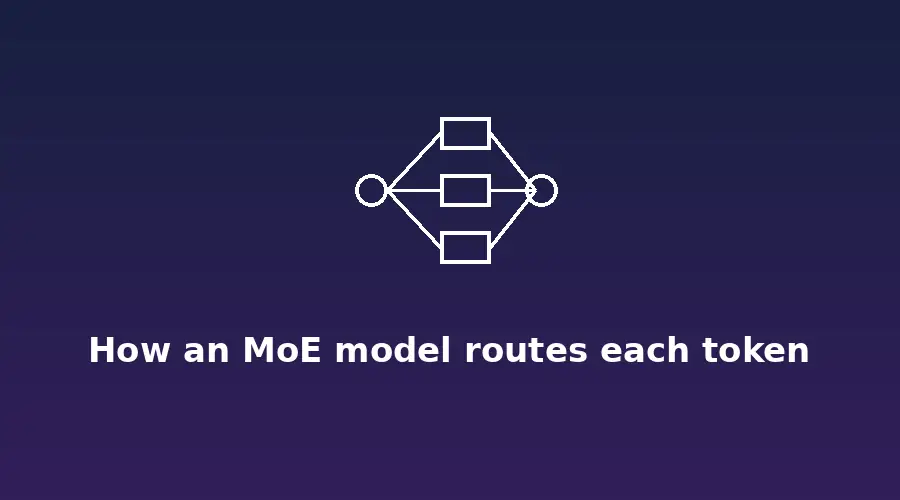
A mixture of experts replaces the feed-forward block in each transformer layer with several parallel blocks — the experts — plus a small router. For each token, the router scores the experts and selects a few. Only those experts run. Their outputs are combined, and the token continues.
The experts are not specialists in any human sense. Nobody assigns one expert to medicine and another to code. They are learned sub-networks, and what each one represents is opaque. The useful part is structural: capacity grows while computation per token stays flat.
The idea predates modern language models. The Switch Transformer (Fedus et al., 2021) showed that routing each token to a single expert could train large sparse models efficiently. Mixtral, DeepSeek, Qwen, and most frontier labs built on that line of work.
How Expert Routing Works
At every MoE layer, the router is a small linear layer that outputs a score per expert. The standard rule takes the top k scores and normalizes them into weights.
Mixtral 8x7B uses eight experts per layer and picks two per token. Qwen3-30B-A3B uses 128 experts and picks eight. DeepSeek-V3 uses a finer-grained scheme with 256 routed experts plus shared experts that always run, so common knowledge is not relearned by every route.
Three properties matter in practice.
Routing changes per token. The same sentence can activate different experts for different words. Nothing about the routing is visible in the output.
Load balancing is a training problem. Routers collapse toward their favorite experts unless pushed. Early approaches added an auxiliary loss that penalized imbalance; that loss trades some quality for stability. DeepSeek-V3 replaced it with an auxiliary-loss-free bias adjustment, letting the router rebalance without degrading the main objective.
Routing is discrete and unstable. Small changes during training flip which experts get selected, which is why MoE training needs careful initialization, learning rates, and checkpoint discipline.
Sparse Activation: Total Parameters vs Active Parameters
This is the number that confuses everyone. Two counts describe every mixture of experts model.
Total parameters is everything stored in the weights. It drives memory.
Active parameters is what computes a single token. It drives speed and cost per token.
Real open-weight figures:
- Mixtral 8x7B: 46.7B total, 12.9B active, 8 experts, top-2. Released December 2023, Apache 2.0.
- Mixtral 8x22B: 141B total, 39B active, same top-2 routing, 64K context. Released April 2024.
- DeepSeek-V3: 671B total, 37B active, 14.8T training tokens. Released December 2024.
- Qwen3-30B-A3B: 30.5B total, 3.3B active, 128 experts, top-8.
- Qwen3-235B-A22B: 235B total, 22B active.
The ratios tell the story. Qwen3-30B-A3B activates roughly 11 percent of its weights per token. DeepSeek-V3 activates 5.5 percent. A dense model activates 100 percent, always.
The catch is memory. Sparsity reduces computation, not storage. Serving Mixtral 8x22B requires the full 141B weights in memory even though only 39B compute each token. At bfloat16 that is roughly 283 GB of weights, which is why quantization and multi-GPU sharding dominate MoE deployment discussions.
Do the Benchmarks Back It Up
Yes, on the numbers the labs published.
The Mixtral 8x7B paper reports MMLU of 70.6 percent versus 69.9 percent for Llama 2 70B, GSM8K math of 74.4 percent versus 69.6 percent, and HumanEval code of 40.2 percent versus 29.3 percent — while using 12.9B active parameters against 70B. Mistral claimed roughly six times faster inference than Llama 2 70B at launch.
DeepSeek-V3 reports 88.5 on MMLU, 75.9 on MMLU-Pro, and 59.1 on GPQA, ahead of every other open-weight model at release and close to GPT-4o and Claude 3.5 Sonnet. Its MATH-500 score reached 90.2. All from a model that activates 37B parameters.
Qwen3-30B-A3B shows the small-model case: 30.5B total, 3.3B active, and reported benchmark results competitive with dense models several times its active size.
The pattern is consistent. A mixture of experts model matches or beats a dense model of similar active parameter count, and approaches dense models with far larger totals. That is the entire economic argument.
Where Training a Mixture of Experts Model Gets Hard
Memory during training. All expert weights live in optimizer state even when only a few compute. Expert parallelism splits experts across devices, which adds all-to-all communication on every layer.
Router instability. Unbalanced routing wastes capacity — some experts starve while others handle everything. Auxiliary losses fix balance but leak into the training objective, and removing them requires careful engineering, as DeepSeek showed.
Evaluation confusion. A model with 671B parameters that activates 37B is not comparable to a dense 671B or a dense 37B. Benchmark tables that mix the two without labeling active parameters mislead buyers.
Fine-tuning and serving. Adapters must be applied consistently across expert weights, and inference engines need fused MoE kernels to realize the theoretical speedup. Naive implementations run slower than a dense model of the same active size.
MoE vs Dense: When Each Wins
Dense models win on memory-bound, low-latency single-stream work: small models on one consumer GPU, simple completion APIs, anything where weights must sit in one device.
Mixture of experts models win on throughput and capability per unit of compute. Batch serving amortizes the router overhead, and the extra stored capacity shows up in knowledge-heavy benchmarks.
For local use, the tradeoff is blunt. A quantized Qwen3-30B-A3B at 4-bit fits comfortably on a single 24 GB card, while Mixtral 8x22B needs roughly 71 GB at 4-bit. Total parameter count sets the floor; active counts only decide how fast you move across it.
Frequently Asked Questions
Is GPT-4 a mixture of experts model
OpenAI has never published GPT-4’s architecture, and the widely circulated 8x22B MoE claim remains unofficial. Treat any specific parameter breakdown for closed frontier models as rumor until the lab confirms it.
Do mixture of experts models need more GPUs
They need more memory, not proportionally more compute. Sharding is about holding all expert weights, while active parameters determine the arithmetic per token.
Can you run an MoE model locally
Yes. Mixtral 8x7B and Qwen3-30B-A3B both run on consumer hardware with quantization. The practical limit is total weight size, not routing complexity.
Does expert routing make outputs less explainable
No more than any other deep network. Experts are opaque either way; what changes is that only a subset participates in each token, which makes mechanistic analysis slightly harder, not the output.
The Bottom Line
Mixture of experts is the dominant efficiency trick in modern language models. A router picks a few experts per token, sparse activation keeps computation small, and total parameter count keeps knowledge capacity large.
The numbers hold up: Mixtral 8x7B beat Llama 2 70B on most benchmarks with a fifth of the active parameters, and DeepSeek-V3 matched frontier closed models while activating 37B of 671B. When you evaluate a model, read both parameter counts, check that the benchmark used a labeled harness, and price your serving hardware against total weights — because that, not the active count, is what fills your GPUs.
Good mixture of experts starts with a golden set of real examples you trust. The point of mixture of experts is to catch regressions before your users do. Whatever your mixture of experts workflow looks like, keep it repeatable and logged. Treat mixture of experts as part of the product, not a one-off test.
Related reading on The LLM News: Open Source LLM | Small Language Models and Agentic AI | How to Run Free Large Language Models Locally
Source: Mixture of experts – Wikipedia | Switch Transformer paper

2 thoughts on “Mixture of Experts Explained: How an MoE Model Cuts Cost With Sparse Activation”